Custom Leggings Manufacturing is the process of creating leggings according to a brand’s specific design, fabric, sizing, and performance requirements. It goes beyond adding a logo to ready-made clothing. Each decision affects comfort, durability, appearance, and production cost.
In practice, the process often begins with a technical pack, artwork files, measurements, and fabric selection. Designers may choose nylon-spandex blends for softness, polyester blends for color stability, or recycled fibers for sustainability goals. Fabric weight, stretch recovery, opacity, and moisture management require careful testing. Small differences can change how leggings feel during yoga, running, or daily wear.
Factories usually develop a prototype before bulk production. A sample can reveal waistband pressure, seam placement, print distortion, or unwanted transparency. These details are easy to overlook. They should not be.
Reliable manufacturers use documented measurements, approved samples, in-line inspections, and final quality checks. They should also explain minimum order quantities, lead times, labeling options, and applicable product safety requirements. Clear communication protects both the buyer and the production team.
Still, Custom Leggings Manufacturing is not a perfectly predictable process. Colors may vary slightly between fabric batches, and recycled materials can show natural differences. A thoughtful supplier identifies these risks early instead of promising effortless results. The strongest partnerships combine practical experience, technical knowledge, transparent testing, and honest discussion. This article explores how custom leggings are designed, sampled, produced, inspected, and prepared for the market.
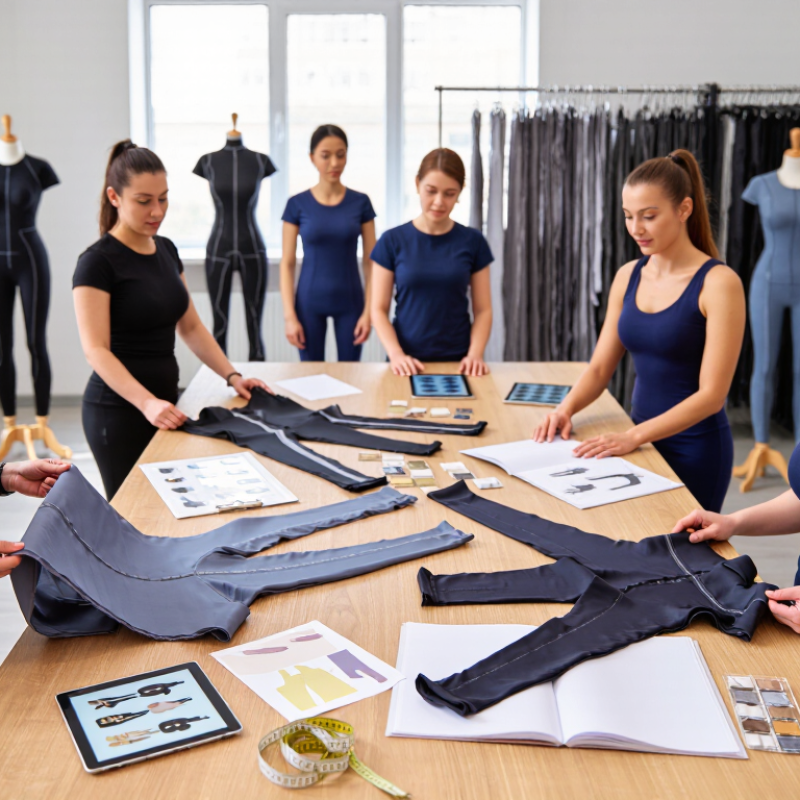
Custom leggings manufacturing is the production of fitted activewear from individually cut fabric panels. It differs from printing ready-made garments. Each panel follows a planned pattern. Workers or automated machines then join the pieces. This is cut-and-sew activewear. The process supports custom waistbands, gussets, pocket placements, seam lines, and leg lengths. Fit drives every decision.
A reliable project begins with a technical package. It normally lists measurements, fabric composition, stretch direction, stitch types, labels, and tolerances. Designers select performance fabrics for recovery, opacity, moisture handling, and comfort. A four-way stretch knit may feel soft, yet become transparent under tension. Testing matters. Sample makers check squat coverage, waistband roll, seam strength, and shrinkage after washing. Size grading then translates one base pattern into several body sizes. This step is often underestimated. Good measurements do not guarantee a consistent fit across every body.
Manufacturing includes pattern development, prototype sewing, revisions, bulk cutting, assembly, inspection, and packing. Quality teams should compare production pieces with the approved sample. They should also record defects instead of relying on memory. A small variance can change how leggings sit during movement. Clear files, measured samples, and written approvals reduce costly confusion. Still, perfection is not automatic. A beautiful prototype may perform poorly during repeated wear. Material availability, machine settings, and operator skill can alter results. Results vary. Custom work is controlled, but never entirely predictable.
Custom leggings manufacturing is the cut-and-sew process of turning a selected stretch fabric, custom pattern, and design specifications into finished activewear. The workflow typically includes development, fitting, material preparation, cutting, sewing, inspection, and packing.
The chart presents a typical small-batch planning benchmark in working days. Actual timing varies according to pattern complexity, fabric availability, sample revisions, order quantity, and production capacity. Several activities may overlap during commercial production.
What Is Custom Leggings Manufacturing?
Material Engineering: 70–80% Nylon and 20–30% Elastane for Stretch
Custom leggings manufacturing begins with fabric engineering, not decoration. A common performance blend contains 70–80% nylon and 20–30% elastane. Nylon provides abrasion resistance, smoothness, and dependable color retention. Elastane supplies stretch and helps the fabric recover after movement.
The exact ratio changes the wearing experience. An 80% nylon blend often feels firmer and more supportive. A 70% nylon blend usually offers greater flexibility and a softer hand feel. However, fiber percentages alone cannot predict quality. Yarn thickness, knitting structure, fabric weight, and finishing treatments also matter. Small differences become obvious during squats.
A practical factory evaluation includes four-way stretch testing, recovery testing, opacity checks, and seam-strength inspection. Technicians should test fabric before and after repeated washing. A fabric may stretch beautifully when new, then lose shape too quickly. That result requires review, not optimistic labeling.
Fit testing should use different body types and movement patterns. The waistband must stay secure without creating uncomfortable pressure. Flat seams can reduce friction during running or training. Moisture management also depends on the knit structure, not only the nylon content. This is where specifications can become imperfect. A higher elastane percentage does not automatically create better leggings. Manufacturers must balance support, comfort, durability, and production consistency for the intended use.
Custom leggings manufacturing begins with fabric behavior, not only visual design.
Four-way stretch allows movement across the body and along the leg. However, stretch alone does not guarantee comfort. A fabric can expand well and still recover poorly after repeated wear.
ISO 20932-1 provides a useful method for measuring stretch and recovery.
Textile Exchange’s 2024 Materials Market Report states that global fiber production reached 124 million tonnes in 2023, with polyester representing about 59%. This explains its common use, but fiber selection must match the garment’s purpose.
GSM affects coverage, compression, warmth, and production cost. For everyday leggings, 220–280 GSM often offers a practical balance. Training styles may require 280–320 GSM for stronger support. These ranges are guidelines, not promises. A dense knit may feel lighter than expected, while a softer fabric can become transparent under tension. Fit tests should include squats, seated movement, waist rolling, and repeated stretching under bright light. One overlooked detail.
Size grading should not enlarge every measurement evenly. The waist, hip, rise, knee, and ankle need different grade rules. Curves also change differently across sizes. A two-centimeter increase at the hip may require a smaller adjustment at the ankle. A gusset can improve mobility, but its shape must follow the crotch curve. No size chart fits every body perfectly. That is where development becomes imperfect, and honest fitting feedback matters. Samples should be tested on several body types before final production.
What Is Custom Leggings Manufacturing?
Custom leggings manufacturing turns a design file into a tested, wearable garment. The workflow usually covers cutting, sewing, printing, and finishing. Material selection comes first. Nylon-spandex and polyester-spandex fabrics are common because they support stretch and recovery. Textile Exchange’s 2024 Materials Market Report states that global fiber production reached 124 million tonnes in 2023. It may reach 160 million tonnes by 2030. That growth makes fabric efficiency and waste control increasingly important.
Cutting begins with graded patterns and fabric relaxation. Operators check grain direction, stretch, and panel alignment before cutting. Poor alignment can distort a waistband or twist a leg seam. Sewing follows, often using overlock and coverstitch machines. Seam tension must match the fabric’s elasticity. Printing may use sublimation or screen-based methods, depending on fiber content and artwork. A small color shift can change the whole product. Finishing includes thread trimming, pressing, label attachment, measurement checks, and final inspection. Many factories use ISO 2859-1 sampling principles, although sampling cannot replace skilled inspection.
Tips: Test a printed and washed sample before bulk production. Check opacity under bright light. Confirm waistband recovery after repeated stretching. Keep a measurement chart beside the sewing line. No process is flawless. Even experienced teams may miss minor shade variation, especially under different lighting. Documenting those errors creates better controls for the next production run.
Custom leggings manufacturing combines fabric selection, pattern development, sewing, inspection, and compliance testing. A practical quality check examines waistband recovery, seam strength, stitching density, color consistency, and print durability. Small defects matter. A twisted waistband can ruin an otherwise attractive garment.
ISO 2859-1 provides a structured sampling method for finished goods. Inspectors select units from a production lot and compare defects with an acceptance plan. AQL 2.5 is commonly used for general inspection, but it is not a promise that 2.5% of garments will be defective. The inspection level, lot size, and defect classification still influence the result. Major and minor defects require clear definitions before production begins.
Chemical safety needs separate attention. REACH controls substances that may affect consumers and the environment in relevant markets. CPSIA applies to children’s products sold in the United States, including requirements concerning lead, phthalates, testing, and product tracking. Suppliers should retain material declarations, laboratory reports, production records, and corrective-action evidence. A clean report is not proof of a perfect pair. Sampling can miss isolated problems, and paperwork can hide weak follow-up. Experienced teams therefore combine documented standards with hands-on checks, repeated measurements, and honest review of failures.
A typical fabric contains 70–80% nylon and 20–30% elastane. Nylon improves smoothness and abrasion resistance. Elastane provides stretch and recovery.
No. Fiber percentages alone cannot predict performance. Yarn thickness, fabric weight, knitting structure, and finishing also matter. That assumption is weak.
Test four-way stretch, shape recovery, opacity, and seam strength. Repeat these checks after washing. New fabric can look excellent, then lose shape quickly.
Test several body types and movement patterns. The waistband should stay secure without painful pressure. Flat seams can reduce friction during running or training.
The workflow includes fabric relaxation, pattern grading, cutting, sewing, printing, trimming, pressing, and final measurement. Each stage can affect fit and appearance.
Operators check grain direction, stretch, and panel alignment. Poor alignment may twist a leg seam or distort the waistband. Small errors become visible during movement.
Wash a printed sample before bulk production. Check color consistency, print durability, and opacity under bright light. Lighting can reveal unexpected shade differences.
Inspect waistband recovery, seam strength, stitch density, measurements, color, and print condition. A twisted waistband can ruin an otherwise attractive garment.
It helps inspectors evaluate a production lot using defined defect limits. It does not prove every garment is perfect. Sampling can miss isolated problems.
Keep material details, laboratory reports, production records, inspection results, and corrective actions. Honest failure reviews improve later production. Paperwork alone is insufficient.
Custom Leggings Manufacturing is the process of developing and producing cut-and-sew activewear according to specific design, performance, and fit requirements. It typically begins with selecting a stretch fabric made from approximately 70–80% nylon and 20–30% elastane, providing durability, softness, shape retention, and flexibility. Designers and manufacturers then evaluate four-way stretch, fabric weight measured in GSM, body measurements, and size grading to create leggings that offer consistent comfort across different sizes.
The manufacturing workflow includes pattern preparation, fabric cutting, precision sewing, printing or decoration, and final finishing. Each stage requires careful control to maintain accurate dimensions, smooth seams, and a professional appearance. Quality and compliance procedures may include inspection practices based on ISO 2859-1 and an AQL 2.5 acceptance level, along with material evaluations aligned with REACH and CPSIA requirements. Together, these processes help ensure that custom leggings meet expected standards for performance, safety, durability, and overall product consistency.